
Edward Norton and Stephen Colbert on Why Action Is The Antidote To Doomscrolling Anxiety
A discussion between Edward Norton and Stephen Colbert on The Late Show (an episode from March 18) was exactly what I needed to hear today.
It’s the third week of the US-Israel war on Iran, and Iran is still retaliating by targeting the UAE and the rest of the GCC countries with daily missile and drone attacks. The UAE continues to be the most targeted, most have thankfully been intercepted. The UAE military and government continue to do their best to protect us and communicating latest developments. But the daily emergency alerts and the sound of loud bangs of intercepted missiles/drones on most days make it difficult to feel at ease, and based on the news, there are no signs of de-escalation.
Apart from spending time with family, I’ve been mostly doomscrolling during the past three weeks because I cannot focus on doing any work. I know it is not good for my mental health, and yet I can’t seem to stop.
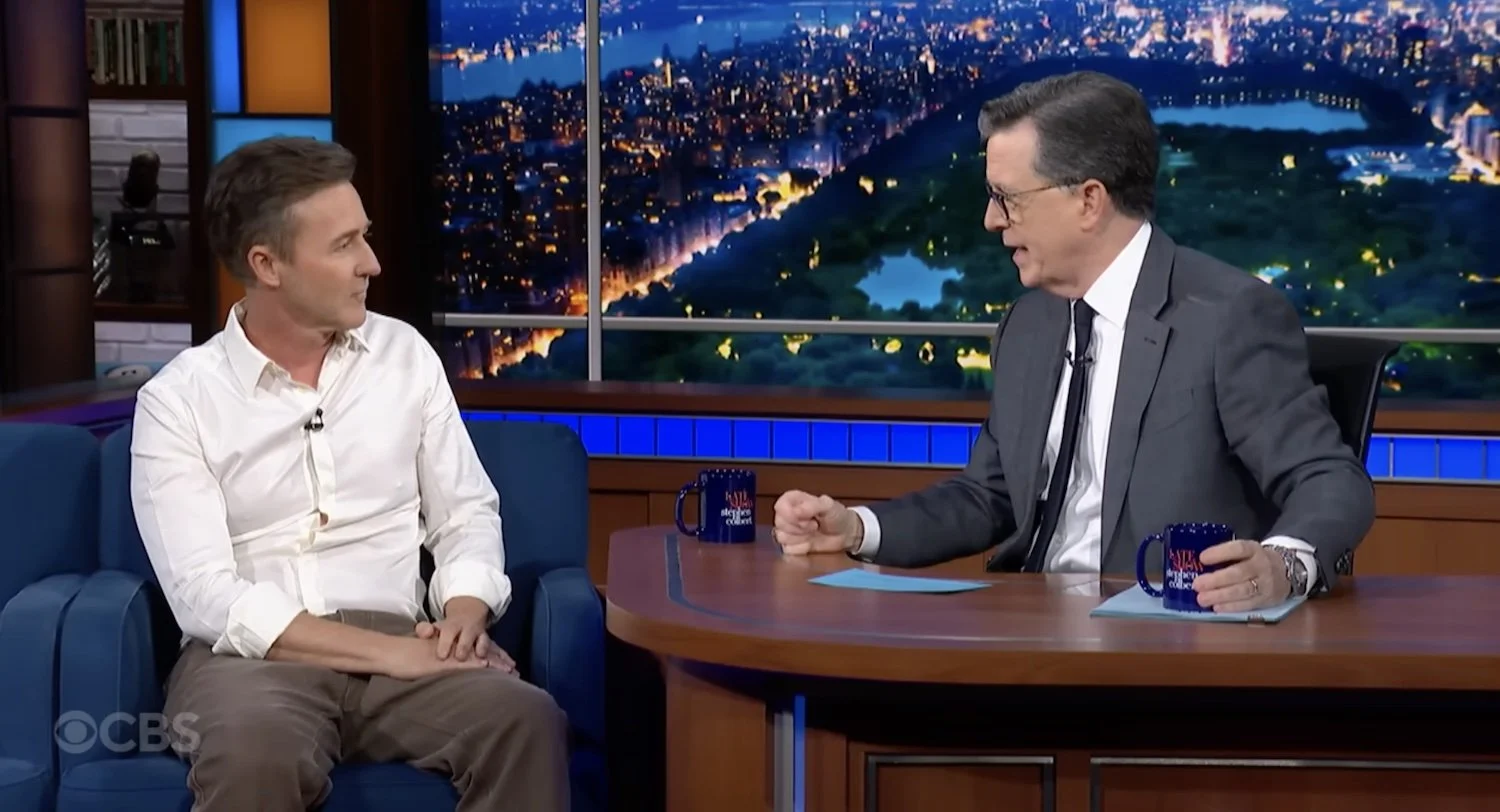
But watching Norton and Colbert discuss how “the onslaught of information” isn’t about the media wanting us to be informed, but to “harvest your anxiety for profit” helped me think about reducing time on my phone.
Edward Norton wasn’t on the show to promote a film, but to talk about how we can all find ways to fight this anxiety and try to do something positive, big or small. He co-founded a barge company called STAX that captures the toxic pollutants found on cargo ships when docked in ports. He explains it is “something to anchor my feet in on a daily basis that makes me feel like I am acting on a daily basis”. Last year, STAX “eliminated the emissions equivalent to 65 million cars being taken off the road”.
Stephen Colbert reminds us that we’re not the only generation dealing with anxiety because of political and social upheavals, and throughout history it has been dealt with “through the art of the time which can speak to something eternal that is in the human experience”.
They both discuss Walt Whitman’s poem Crossing Brooklyn Ferry , what it means to Norton and how it has the “electrifying capacity to sound like he's sitting here with us right now talking about anxieties and joys, and how to balance them”.
Norton then recites the poem, combined with lines from Song of Myself, also by Whitman.
I believe poetry should be heard and not read, and was moved by Norton’s performance after discussion.
More of this needs to be shown on American television. But sadly, The Late Show will end on May 21, and another example of how serious talk shows like this that “talk about the hard stuff”, just like journalism are being chipped away more and more, faster and faster in the American media landscape.
You can watch the complete discussion below, and I transcribed parts of the discussion and the poem which you can read below the video in case you don’t have time to watch all 20 minutes.
Edward Norton: …in all seriousness I do look at what's going in this country, in the world, and it gives me enormous anxiety. I want to say I really have always appreciated, we all appreciate that you make space and time on the on this show to talk about the hard stuff, grief and faith, and it's been a real gift to everybody. I think that it is worth acknowledging that the anxiety of these times is particularly intense for a lot of people right now. I think that we know the world is effed up in ways that are unprecedented in our lifetimes. But we also live in this unbelievable onslaught of information.
We see genocide being live streamed to us. We see American citizens being killed by paramilitary people in our own streets for standing in solidarity with their neighbors. We're seeing Epstein's abuses titrated into us on a daily basis. It is such a conundrum because we know that there's a value, we know that it's good in some ways to know what is actually happening. To know what's happening in Gaza, to know what's happening in Ukraine and Sudan and Minneapolis. But at the same time it is very difficult to know what we as an individual person can do about all of that while moving through our day.
I have found it very difficult, really struggled in my anxiety about it all with the idea even of making art anymore. I really have gotten to the point that, you were asking about movies, I'm not sure I haven't lost my conviction that movies aren't a frivolity that we can't afford right now. As I've gone through that…you say why do something like this? Well, I have noticed in myself over the last few years that if I doomscroll and stay in it, I can really go down a hole, as we all can. And I think that for me, the only antidote to the anxiety has been action, some kind of action. I think…when we're here we have to speak out against war, especially illegal, asymmetric war being waged against civilians no matter what the rationale. And against the idea that law enforcement should ever wear a mask. I don't think nobody but an actor or a child on Halloween should be wearing a mask in the street trying to scare somebody. That is not what law enforcement that respects the second, first, and fourth amendments does to its own citizenry. We know that's not right.
Stephen Colbert: The doom scrolling is how we get so much of that information these days, which of course has very little to do with wanting to inform you. It actually wants to harvest your anxiety for profit. I think less that we're being informed and more we're under psychological attack at all times…both forces inside and outside of our country. To confuse us about the reality of the world and to merely pull us into the hole because that's where they want to keep us in order to harvest our information, in order to make a profit off of what it's like to be a human being in the face of both joy and horror at the same time.
Edward Norton: I think it's a great way of putting it because I think we have to understand the side of ourselves and see that induced anxiety, intentionally induced anxiety is intended to cause paralysis. It is intended to in a way keep us from acting…You say why do this, like capturing the emissions off of boats has nothing to do with ICE or Gaza. I can't remediate those things with anything other than my voice, but at least it gives me something to anchor my feet in on a daily basis that makes me feel like I am acting on a daily basis.
Everybody's got something everybody's got something small that they're good at that they can contribute, and the total collective weight of that is Pete Seeger's Teaspoon Brigade that we talked about a year ago. We do need to all pick up our teaspoons and do something, and we really need I think to not listen to people saying actor stay in your lane, but we are American citizens and anyone who says stay in your lane tell them to get stuffed. In my view I think we have two lanes. We have a lane in which you have conviction that the rule of law and democracy and compassion are the fundamental tenants of American society, and in the other lane, you believe that those things are inconvenient to power. And that lane has gotten really loud and unapologetic, and we need to be loud in our lane. You've been loud. This show is closing down because you got so loud, and the rest of us the rest of us need to pick that microphone up and keep being loud.
Stephen Colbert: As intense as things seem right now, there is solace and knowing that people from every generation have dealt with their moments of anxiety. And often that is expressed through the art of the time which can speak to something eternal that is in the human experience. You and I both are big fans of Walt Whitman, who not enough people read anymore. You and I were talking about Crossing Brooklyn Ferry and I'm wondering what that poem means to you.
Edward Norton: I think that you're 100% right. And I will say even when the wonderful Ian McKellen, who's really a mentor and friend and inspiration of mine since I was a teenager, when he came out here and read Shakespeare's text about the immigrant, it's the rebuttal to what I was saying about art feeling like frivolity because there are times whether it's Shakespeare or Bob Dylan and Pete Seeger, and revisiting what they had to say…When you realize that artists are capable of speaking through time in some sense and reminding us that everybody in every time has gone through these moments, these anxieties. Everyone has struggled with their chapter of anxiety, and in that sense of bondedness, there's maybe some hope, I think.
I do think Whitman, of all American poets, he really seemed to understand that though he stood somewhere in time, he was speaking to you and me right now. and he was thinking about us. He wanted to convey in some sense that we're still in this all together. Crossing Brooklyn Ferry and also Song of Myself, he has the most electrifying capacity to sound like he's sitting here with us right now talking about anxieties and joys, and how to balance them.
For the Whitman purist…it would take 20 minutes. I've taken the liberty of distilling a little bit of Crossing Brooklyn Ferry and even Song of Myself because I think in both of those poems he spoke to so much of what we're all going through and what we're talking about here.
I'll set the scene. Remember that Walt Whitman almost daily walked across the Brooklyn Bridge to Manhattan here. And this is 170 years ago…he wrote these lines about standing on the Brooklyn Bridge crossing from Brooklyn into Manhattan.
Flood tide below me. I see you face to face.
Clouds of the west, sun there half an hour high. I see you also face to face.
Crowds of men and women attired in the usual costumes on the ferryboats.
The hundreds and hundreds that cross returning home are more curious to me than you suppose.
And you, you, Steven Colbert from New Jersey, you and you that shall cross from shore to shore years hence are more to me and more in my meditations than you might suppose.
Just as you feel when you look on the river and the sky, so I felt.
Just as any of you is one of a living crowd, I was one of a crowd.
Just as you are refreshed by the gladness of the river and the bright flow, I was refreshed.
So what is it then between us?
What is the count or the scores of hundreds of years between us?
Whatever it is, it avails not. Distance avails not. And place avails not. I too lived.
Brooklyn of Ample Hills was mine.
I too walked the streets of Manhattan Island. I too felt the curious abrupt questionings stir within me in the day among crowds of people.
Sometimes they came upon me in my walks home late at night or as I lay in my bed. They came upon me.
It is not upon you alone. The dark patches fall.
The dark threw its patches down on me also. The best that I had done seemed to me blank and suspicious. My great thoughts, as I suppose them, were they not in reality meager?
Nor is it you alone who know what it is to see evil.
I knew what it was to see evil.
Lies, theft, grudges, guile, anger, lust, vanity, greed. The shallow, sly, cowardly, and malignant. Hate, meanness, meanness, battles, the horrors of fratricidal war, the fever of doubtful news, the fitful events.
These come to me days and nights and go from me again. But they are not the me myself.
You men and women of a generation 50 years hence, a hundred years hence, or ever so many hundred years hence, I am with you.
There was never any more inception than there is now, nor any more youth or age than there is now, and will never be any more perfection than there is now, nor any more heaven or hell than there is now.
So flow on river, flow on with the flood tide, ebb with the ebb-tide.
Gorgeous clouds of the sunset drench with your splendor me or the men and women of generations after me.
Stand up. Tall masts of manahhata. Stand up. Beautiful hills of Brooklyn.
Throb baffled curious brain. Throw out questions and answers. Live, live old life.
Play the part that looks back on the actor or the actress. The role that's as great or small as one makes it, but play your role.
Thanks to Todd Reisz for bringing this to my attention.